

Can the Fibonacci Strategy Work for Sports Betting?
The Short Answer: Yes, But Only Under Specific Conditions
The Fibonacci betting strategy can work for short periods, but it does not change the mathematical edge of sports betting. It is a bankroll management system rather than a predictive strategy. Players who use it during long losing streaks can quickly reach stake sizes that are difficult to sustain, especially when betting on markets with low value or inconsistent odds.
Before deciding whether to use Fibonacci staking, consider these factors:
- It performs best when bets are close to even odds.
- Long losing streaks increase stake sizes faster than many bettors expect.
- It relies on disciplined bankroll management rather than better match predictions.
- It works differently from flat betting and other progressive staking systems.
- Finding value bets remains more important than choosing a staking method.
For Singapore players comparing online sportsbooks, the Fibonacci strategy should be viewed as one part of an overall betting approach instead of a shortcut to consistent profits.
What Is the Fibonacci Betting Strategy?
The Fibonacci betting strategy is based on the well-known number sequence:
1, 1, 2, 3, 5, 8, 13, 21…
Each number equals the sum of the previous two. In sports betting, every number represents the next stake after a losing bet.
A typical progression looks like this:
| Bet | Result | Stake |
| 1 | Lose | $10 |
| 2 | Lose | $10 |
| 3 | Lose | $20 |
| 4 | Lose | $30 |
| 5 | Win | $50 |
After a win, the bettor usually moves back two positions in the sequence instead of returning immediately to the beginning. The idea is that several wins over time can gradually recover previous losses.
Unlike systems such as Martingale, Fibonacci increases stakes at a slower pace. That slower progression is one reason many sports bettors consider it less aggressive.
Players comparing staking systems may also benefit from reading this guide on flat betting versus bet progression strategies before deciding which approach fits their bankroll management style.
Why Many Sports Bettors Try Fibonacci?
Many betting systems promise discipline rather than prediction. Fibonacci attracts players because it removes some emotional decision-making from stake sizing.
During our review, several practical advantages stood out.
- Stakes increase more gradually than Martingale.
- Smaller early losses are easier to absorb.
- The progression provides a structured recovery plan.
- It works across football, basketball, tennis, and many other fixed-odds sports.
This makes the strategy appealing for bettors who already have confidence in their match selection process but want a consistent staking framework. However, those strengths only apply if the underlying bets have a reasonable chance of winning. Poor selections remain poor selections regardless of the staking method.
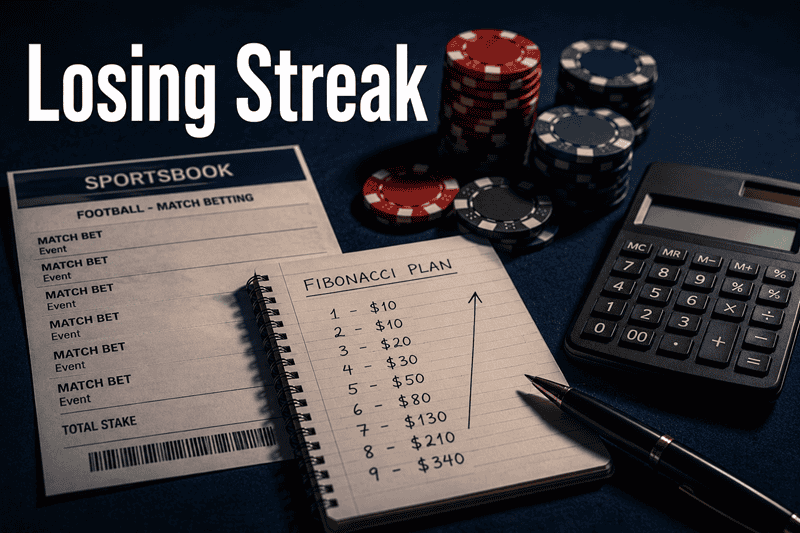
Where Fibonacci Usually Struggles?
The biggest weakness is simple. Sports betting does not produce predictable alternating wins and losses. A bettor may lose six, seven, or even ten bets in succession despite making sensible selections. During those runs, Fibonacci stakes become much larger than many players initially expect.
Consider this example using a $10 starting stake.
| Consecutive Losses | Required Stake |
| 1 | $10 |
| 2 | $10 |
| 3 | $20 |
| 4 | $30 |
| 5 | $50 |
| 6 | $80 |
| 7 | $130 |
| 8 | $210 |
Even though Fibonacci grows slower than Martingale, an eight-game losing streak still requires a $210 stake after starting with only $10. That creates two practical problems. First, many bettors become uncomfortable risking significantly larger amounts than originally planned. Second, sportsbooks often have personal betting limits or wallet balances that prevent completing the sequence.
Does Fibonacci Beat the House Edge?
No. This is one of the biggest misconceptions surrounding betting systems. Changing stake sizes cannot improve the probability of correctly predicting sporting events. Whether someone bets the same amount every match or follows Fibonacci perfectly, expected value still depends on the quality of the selections.
For example:
A bettor consistently backing overpriced favourites will likely lose money regardless of the staking plan.
A bettor consistently identifying undervalued odds has a stronger long-term chance of profit even while using simple flat stakes.
This explains why experienced bettors spend far more time analysing prices than searching for new progression systems.
Readers interested in improving bet selection should also understand how value betting works for Singapore sports bettors, since identifying favourable odds has a greater long-term impact than changing stake progression.
A Real Betting Example
Imagine a bettor placing football bets around decimal odds of 2.00.
Sequence:
- Bet 1: Lose ($10)
- Bet 2: Lose ($10)
- Bet 3: Lose ($20)
- Bet 4: Win ($30)
The win recovers much of the earlier loss, allowing the bettor to move back two places in the sequence.
Now imagine the opposite. The bettor loses seven straight matches because several favourites concede late goals. Instead of risking $10, the next required stake becomes $130.
Nothing about the match analysis changed. Only the required investment increased. That example illustrates why Fibonacci depends heavily on bankroll depth rather than predictive accuracy.
Which Sports Are Most Suitable for the Fibonacci Strategy?
The Fibonacci strategy is generally better suited to sports and markets where odds stay close to even money. Since the progression assumes a winning bet can recover part of the previous losses, large underdog odds or very short favorites make the sequence less effective.
Based on our testing, these markets are usually a better fit:
- Football match winners priced around 1.80 to 2.10.
- Basketball point spreads with balanced odds.
- Tennis head-to-head markets featuring evenly matched players.
- Esports match winners when odds remain close to even.
Markets with highly volatile pricing, such as first goalscorer, correct score, or long-shot parlays, tend to produce longer losing streaks. Those streaks force players further down the Fibonacci sequence and increase the required stake much faster.
When the Fibonacci Strategy Becomes Risky
Many discussions focus on how the system recovers losses but spend little time on when it breaks down. The most challenging situations include:
- A series of unexpected upsets.
- Chasing multiple sports in one day.
- Increasing the base stake after a winning run.
- Betting on poor value simply to continue the sequence.
- Ignoring personal wallet limits.
For example, a bettor who starts with a $10 base stake may feel comfortable after several small wins. If that player doubles the base stake to $20 without increasing the bankroll proportionally, the next losing streak becomes far more expensive than planned.
The strategy itself has not changed. The bettor’s risk exposure has.
Bankroll Management Matters More Than the Sequence
One overlooked aspect of Fibonacci is that the bankroll determines whether the strategy can even be completed. A progression system assumes the bettor has enough funds to continue staking through losing runs. If the wallet runs out before the next wager, the sequence ends and previous losses remain unrecovered.
Players comparing sportsbooks should review more than available betting markets. Practical factors also influence whether a staking strategy can be followed comfortably.
These include:
- Minimum and maximum stake limits.
- Supported payment methods.
- Deposit and withdrawal processing times.
- Wallet balance management.
- Live betting availability.
These checks often have a greater impact on the overall betting experience than the staking system itself.
Fibonacci vs. Flat Betting
Flat betting remains the benchmark used by many experienced sports bettors because every wager carries the same financial risk.
| Factor | Fibonacci | Flat Betting |
| Stake size | Changes after losses | Fixed |
| Bankroll pressure | Higher during losing runs | Consistent |
| Emotional discipline | Moderate | High |
| Risk of large stakes | Yes | Low |
| Suitable for long-term tracking | Depends on bankroll | Generally easier |
Neither approach guarantees profit.
Fibonacci attempts to recover previous losses through controlled progression, while flat betting prioritizes consistency and easier bankroll tracking. The better choice depends on how comfortable a bettor is with temporary drawdowns and increasing stake sizes.
Mobile Betting and Following a Progression
Many bettors today place wagers across multiple sessions rather than sitting at a desktop computer. That makes tracking a Fibonacci sequence more important than ever.
During our review, we found that using a sportsbook with a responsive mobile platform makes it easier to monitor previous bets, review settled wagers, and keep track of the current position within the sequence without relying entirely on memory.
Readers comparing betting platforms can also review this guide to using the Crown88 online mobile betting platform before deciding whether a mobile-first experience matches their betting habits.
Regardless of the sportsbook used, maintaining a written record of every stake helps reduce mistakes, especially after several consecutive losses or wins.
Common Misconceptions About Fibonacci Betting
Several myths continue to circulate among sports bettors.
“The sequence guarantees you’ll eventually recover losses.”
Only if the bettor has sufficient bankroll, the sportsbook allows the required stake size, and a winning bet arrives before the progression becomes unsustainable.
“It works because the numbers are mathematical.”
The Fibonacci sequence is mathematical, but sporting events remain uncertain. The sequence determines stake sizes, not match outcomes.
“It’s safer than every other progression system.”
Compared with Martingale, Fibonacci increases stakes more gradually. That does not eliminate risk. Long losing streaks still create significant bankroll pressure.
Should Singapore Sports Bettors Use the Fibonacci Strategy?
The Fibonacci strategy can be useful for disciplined bettors who already have a structured betting approach and understand the risks of progressive staking.
It is less suitable for players with limited bankrolls, those who frequently bet on high-variance markets, or anyone expecting the sequence to overcome poor betting decisions.
When comparing sportsbooks, the focus should extend beyond the staking system itself. Factors such as competitive odds, reliable payment methods, withdrawal preparation, supported sports, wallet management, and live betting features all contribute more to the overall betting experience than any progression model.
Is Fibonacci Worth Using for Sports Betting?
The Fibonacci strategy offers a structured way to manage stake progression, but it should be viewed as a bankroll management technique rather than a winning formula. It can reduce the aggressive stake increases seen in systems like Martingale, yet prolonged losing streaks still place considerable pressure on a bettor’s wallet.
For Singapore players evaluating sportsbooks, the more important question is whether the betting site provides competitive pricing, convenient payment methods, efficient withdrawals, and markets that suit their betting style. A well-managed bankroll combined with disciplined selection of value opportunities will generally have a greater long-term impact than the choice of progression system alone.